To check Denver air quality where you actually live, pair an official monitor reading with the nearest neighborhood sensor, then glance at the Front Range forecast before you plan your day. Most of what matters in Denver's air is invisible, so the readings do the seeing for you.
TL;DR Quick Answers
denver air quality
Denver air quality shifts block by block, so the metro AQI only tells part of the story. Check the official AirNow reading first, then the nearest Love My Air sensor for your street. Ozone peaks on summer afternoons, while smoke and winter inversions drive fine-particle spikes, and both slip indoors through your return vent.
Where it stands: The 2026 State of the Air report ranked the Denver-Aurora-Greeley metro 8th worst in the nation for ozone.
Why neighborhoods differ: Globeville and Elyria-Swansea, beside the I-25 and I-70 interchange, carry a heavier pollution burden than the city average.
When to check: Look before afternoon exercise in summer and on still winter mornings, and sign up for Colorado's Action Day email alerts.
How to read two tools: When a neighborhood sensor agrees with the official monitor, trust the number. When only the sensor spikes, give it an hour.
What to do inside: Close the windows, set the thermostat fan to On, and use a MERV 8 filter or the highest rating your system can handle.
Top Takeaways
• A citywide AQI averages the whole region, and your block can run higher, especially near highways and industrial corridors.
• Pair an official monitor with the closest neighborhood sensor, then check the Front Range forecast.
• Ozone peaks on summer afternoons, while fine particles spike during smoke events and winter inversions.
• Low-cost sensors are quicker and closer but less precise. When one agrees with a monitor, act on it, and when it doesn't, wait an hour.
• Outdoor air reaches your living room fast, so a fresh filter and a fan set to On are your first line of defense.
Why Denver Air Quality Changes From One Neighborhood to the Next
Traffic and industry explain most of the difference between one Denver block and the next. Terrain decides how long the mess hangs around.
Highways and Industry
North Denver shows it most clearly. Globeville and Elyria-Swansea sit beside the I-25 and I-70 interchange everyone calls the Mousetrap, with a refinery just to the north. When Colorado State University researchers and neighborhood residents published their 2025 community health study, they found adult asthma hospitalization rates 39% higher in Globeville and 57% higher in Elyria-Swansea than the Denver average. They also measured elevated nitrogen dioxide and coarse particles, and most low-cost particle sensors don't track either one. So even a good neighborhood sensor can miss part of the picture.
Inversions and Afternoon Ozone
On still winter mornings, cold air settles into the South Platte River valley below the foothills and holds wood smoke and exhaust close to the ground. That's the brown haze longtime residents recognize on sight. Summer flips the problem. Sunlight bakes tailpipe and industrial emissions into ground-level ozone, which builds through the day and peaks mid to late afternoon without leaving a trace you can see. A clear blue sky over Washington Park can still come with an Action Day alert.
How to Check Denver Air Quality Where You Live, Step by Step
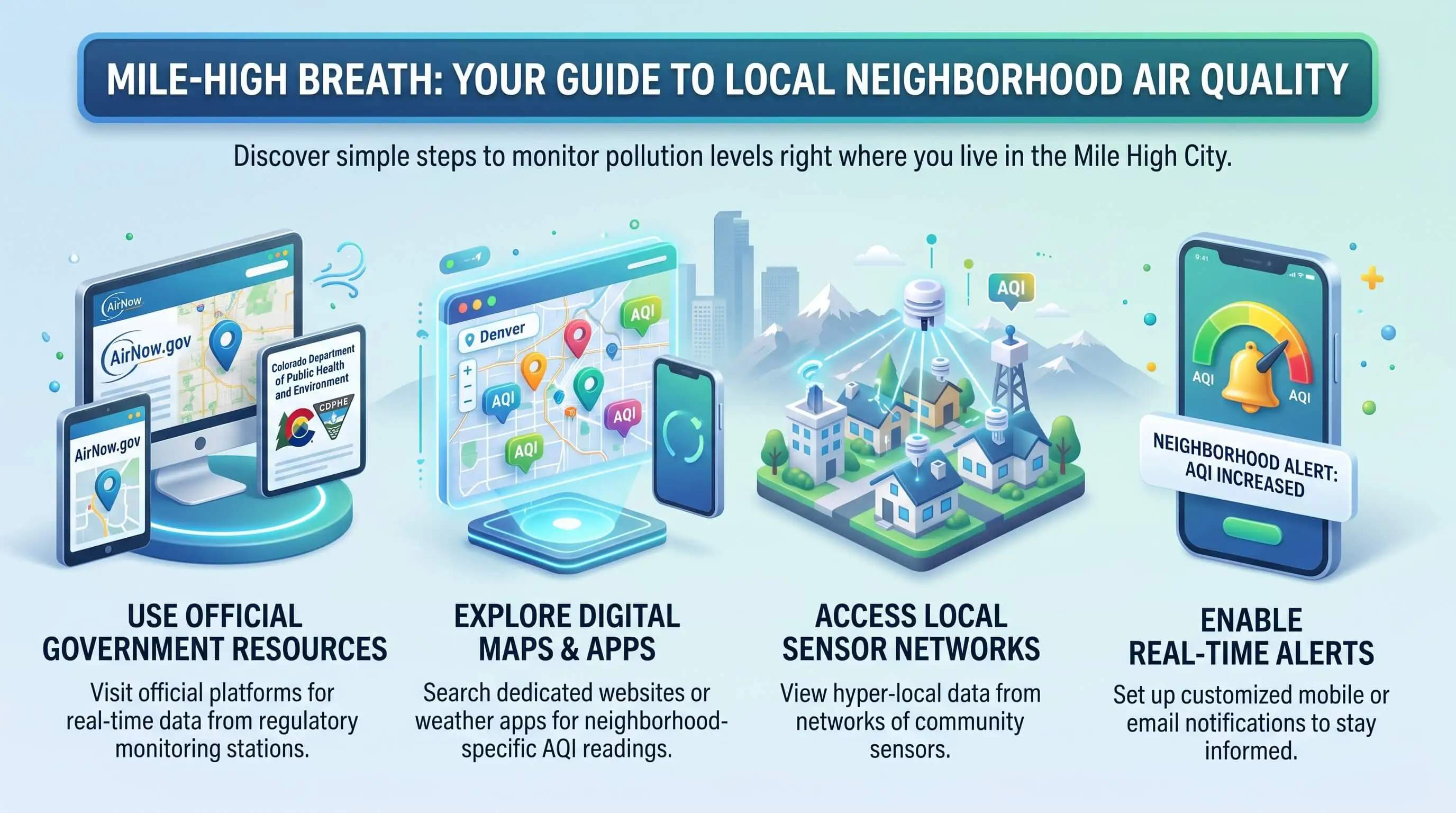
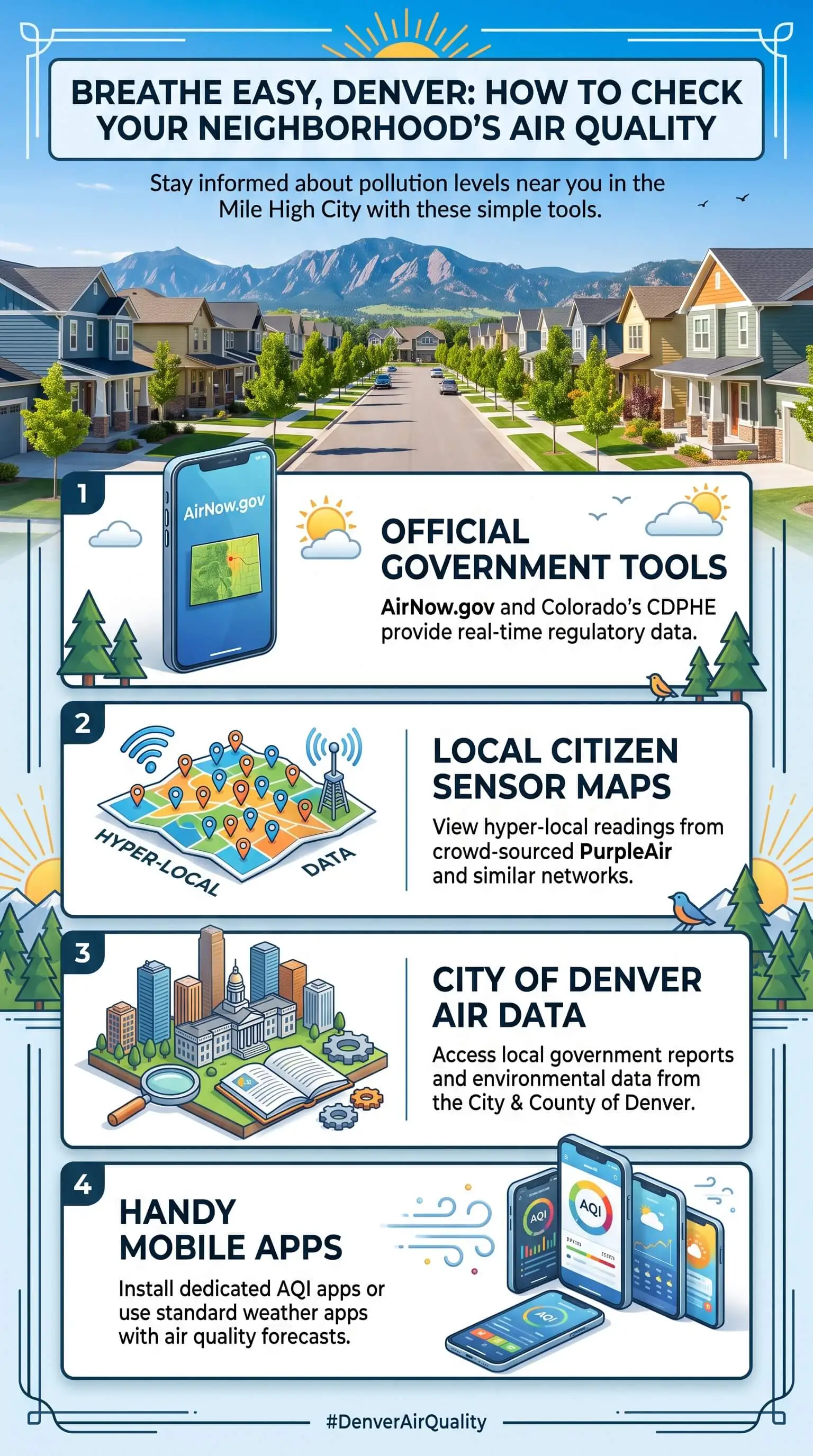
1. Start with the official reading. Type your ZIP code into AirNow. The regulatory monitors behind it are few and far between, but they're carefully calibrated, which makes them your baseline.
2. Check the live Denver AQI map. The real-time map I list first in the resources below shows how readings move across the metro hour by hour.
3. Zoom in with Love My Air. The City of Denver runs this sensor network at schools and community sites and posts particle readings in real time. Find the sensor closest to your front door.
4. Read the Front Range forecast. The state health department publishes a daily forecast and issues Action Day alerts when it expects ozone or fine particles to reach unhealthy levels. Sign up for the email alerts so the warning comes to you.
5. Figure out which pollutant is driving the number. If it's ozone, ease off afternoon exertion. If it's fine particles, close up the house and let your filter do its job.
6. Pull your own return filter. A gray, loaded, or overdue filter means your HVAC system is recirculating whatever just blew in.
How to Read a Neighborhood Sensor Next to an Official Monitor
Sensors and monitors answer different questions. Regulatory monitors are sparse but precise, while low-cost PM2.5 sensors sit closer to you and react faster. EPA's own sensor guidance warns that those sensors carry more uncertainty, and fog, humidity, and temperature can all throw them off.
Pro Tip. When the sensor and the monitor agree, trust the number. When the sensor runs higher, give it an hour before you react. A single spike usually traces back to something on your street, like an idling delivery truck or a neighbor's fire pit, while a reading that holds steady points to a real trend on your block. Keep in mind that a five-minute sensor reading isn't the same thing as the AQI, which EPA builds from longer averages, and factors such as home insulation can also affect how much outdoor pollution makes its way inside.
What to Do When Your Neighborhood Reading Climbs
Outdoor air doesn't stay outside. It slips in around doors and windows, and your return vent pulls it straight into the system. Once the number climbs past Moderate, here's what I'd do.
• Close up the house. Shut the windows and doors, and switch any fresh-air intake to recirculate.
• Set the thermostat fan to On. Continuous airflow pushes more room air through the filter than the Auto setting does.
• Match the filter to the air. Federal smoke guidance recommends MERV 13, or the highest rating your system can handle.
• Book a tune-up before smoke season. A technician can confirm your blower moves enough air through a denser filter, so you aren't finding out in the middle of August.
• Check the filter more often. A week of smoke or winter inversions loads a filter faster than the calendar suggests.
"I've pulled filters on both sides of I-70 for years, and I can usually guess how close a house sits to the highway before I read the address. The closer to the interchange, the faster the filter fills with fine gray soot, because the return pulls in whatever drifts across the yard all day."
7 Essential Resources
1. Live Denver AQI Map: Real-time air quality index readings for Denver, updated through the day so you can watch conditions shift.
2. AirNow Fire and Smoke Map Information: How the federal map combines official monitors with corrected low-cost sensor data, which makes it the easiest place to compare the two side by side.
3. Love My Air, City and County of Denver: The city's own monitoring network, running since 2018, with live readings from sensors at schools and community sites.
4. Front Range Air Quality Forecasts and Advisories: Colorado's daily forecast and Action Day notices for the Denver metro, plus the sign-up link for email alerts.
5. Using Air Quality Sensors for Smoke: Understanding Sensor Data: EPA's plain-language guide to what sensor readings can and can't tell you, including how to spot a unit that's failing.
6. Safety Guidelines: Wildfires and Wildfire Smoke: CDC's steps for keeping smoke out of your home, with filter and recirculation settings.
7. GES Community Health Study Interactive Mapping Tool: Neighborhood-level environmental and health maps for Globeville and Elyria-Swansea.
3 Supporting Statistics on Front Range Air
1. 66 days over the ozone standard in 2026. The Regional Air Quality Council counted 66 days this summer when Front Range ozone topped the federal standard, which puts 2026 among the toughest seasons since 2000. That's a lot of afternoons when a quick check before heading outside paid off. Source: Regional Air Quality Council, 2026 Ozone Season Data
2. 8th worst in the nation for ozone, with the burden shifting by county. The American Lung Association's 2026 State of the Air report ranked the Denver-Aurora-Greeley metro 8th worst for ozone. Jefferson County averaged 29.7 unhealthy ozone days a year, while Adams County logged the area's worst short-term particle pollution, so the problem you face depends on where you live. Source: American Lung Association, State of the Air 2026: Colorado
3. Severe nonattainment since October 2022. On October 7, 2022, EPA moved the nine-county Denver Metro/North Front Range area to Severe nonattainment for the 2008 ozone standard, a designation that reflects years of readings above the federal limit. Source: Federal Register, Denver Metro/North Front Range Ozone Plan
Final Thoughts and Opinion
The metro AQI is where I start, never where I stop. Denver's air changes block by block, and every tool you need to see that difference is free and already on your phone. What matters is the habit of pairing two readings before trusting either one.
Most people skip the inside of the house, and that's the part you control. You can't stop what drifts down the Front Range. You can decide whether your return vent pulls it through a fresh filter or a loaded one, and a regular HVAC tune up helps make sure the system is ready to move and filter that air properly. That choice puts you in charge of the air your family breathes. Check the block, then check the filter.
Frequently Asked Questions
Is Denver air quality bad today?
That depends on your neighborhood and the time of day. Pull the official reading on AirNow, then check the closest Love My Air sensor for your block. On a state-issued Action Day, sensitive groups should cut back on time outdoors, and during ozone alerts everyone should skip hard afternoon workouts.
Why is Denver air quality worse on summer afternoons?
Sunlight reacts with vehicle and industrial emissions to form ground-level ozone, so levels climb through the day and usually peak mid to late afternoon. Summer heat and long daylight hours speed that reaction up. During ozone season, plan outdoor exercise for the morning.
Which Denver neighborhoods tend to have the worst air?
Neighborhoods beside major highways and industry carry the heaviest documented burden, especially Globeville and Elyria-Swansea near the I-25 and I-70 interchange. Smoke and ozone still reach every corner of the metro, though, so a local reading is worth checking wherever you live.
Are neighborhood air sensors accurate enough to trust?
They're good enough to spot trends and compare locations, though less precise than official monitors, and fog or humidity can push their readings high. Compare your sensor with the nearest regulatory monitor. If both move the same direction, act on it. If only the sensor spikes, give it an hour.
Does an HVAC tune-up help indoor air during bad air days?
Yes, though indirectly. A tune-up confirms your blower can pull room air through a higher-efficiency filter, and a technician will catch loaded filters, leaky returns, and dirty coils before smoke season arrives. The filter traps the particles, and the tune-up makes sure your system can keep up with it, which can also help you avoid unexpected issues that may add to your HVAC system cost.
Check Your Block Before You Open the Windows
Checking air quality in your Denver neighborhood takes two readings and about two minutes. Build it into your morning routine, and let your block's number, not the metro average, guide when you open the windows and when top air filters need to handle more of the indoor load.