A higher MERV rating tells you a filter can trap smaller particles. Your air only gets cleaner if your system can pull enough air through that filter, the frame seals tight in its slot, you change it on time, and the fan runs long enough to do the work. Skip those checks and the "higher is always better" assumption can leave you with stuffy rooms, longer run cycles, and a bigger energy bill. The good news is that you can check every one of them yourself.
TL;DR Quick Answers
MERV rating chart
A MERV rating chart ranks air filters from 1 to 16 by the smallest particles each one reliably traps, from 0.3 to 10 microns. Higher numbers catch finer particles but add airflow resistance, so the best rating for your home is the highest one your HVAC system can comfortably pull air through.
MERV 1 to 4: Catches particles over 10 microns, like pollen and carpet fibers. Mostly protects equipment.
MERV 5 to 8: Traps 3 to 10 micron particles, including mold spores and pet dander. This is standard for most homes.
MERV 9 to 12: Captures 1 to 3 micron particles, such as lead dust and vehicle exhaust.
MERV 13 to 16: Targets 0.3 to 1 micron particles, including bacteria and most smoke. The top end is built for hospitals.
Read it as a floor: Each rating reflects a filter’s weakest lab performance at controlled airflow.
Check your system first: EPA research found MERV 7 to 13 filters come close to HEPA at removing household allergens, without the heavy airflow penalty.
Top Takeaways
A MERV rating measures a filter's minimum particle capture in a lab, and it can't tell you how clean your home's air is.
Higher ratings add airflow resistance, and a blower that can't keep up filters less air every hour.
Fit, change schedule, and fan run time matter as much as the rating.
A 4-inch or 5-inch filter reaches higher MERV ratings with less restriction than a 1-inch filter.
A static pressure check at your next tune-up shows how high you can safely go.
What a MERV Rating Actually Measures
MERV stands for Minimum Efficiency Reporting Value. ASHRAE introduced the scale in 1987, and labs now test filters to it under Standard 52.2, scoring them from 1 to 16. The test loads a filter with dust and counts particles on both sides across three size bands, from 0.3 to 10 microns.
Pay attention to the first word. "Minimum" means the rating reflects the filter's weakest moment in testing, so you're looking at a dependable floor. That score also came from a lab running at controlled airflow, and your return duct doesn't run on lab conditions.
MERV Rating Chart: What Each Range Captures
A MERV rating chart sorts all 16 ratings by the smallest particles each range catches reliably. Here's how the bands break down:
MERV 1 to 4: Particles larger than 10 microns, like pollen, dust mites, and carpet fibers. Filters in this range mostly protect your equipment.
MERV 5 to 8: Particles from 3 to 10 microns, including mold spores and pet dander. Most standard home filters sit here.
MERV 9 to 12: Particles from 1 to 3 microns, such as lead dust and vehicle exhaust. This is the upper end of residential filtration.
MERV 13 to 16: Particles from 0.3 to 1 micron, including bacteria, sneeze droplets, and most smoke. Designers built the top of this band for hospitals.
This next point catches most homeowners off guard. EPA research summarized on that same MERV reference page found that medium-efficiency filters rated MERV 7 to 13 come close to true HEPA filters at removing allergens in home air handlers, and they do it without the heavy airflow penalty. That finding alone tells you the biggest number is rarely the smartest buy.
Why a Higher MERV Rating Doesn't Automatically Mean Cleaner Air
Airflow Resistance and Pressure Drop
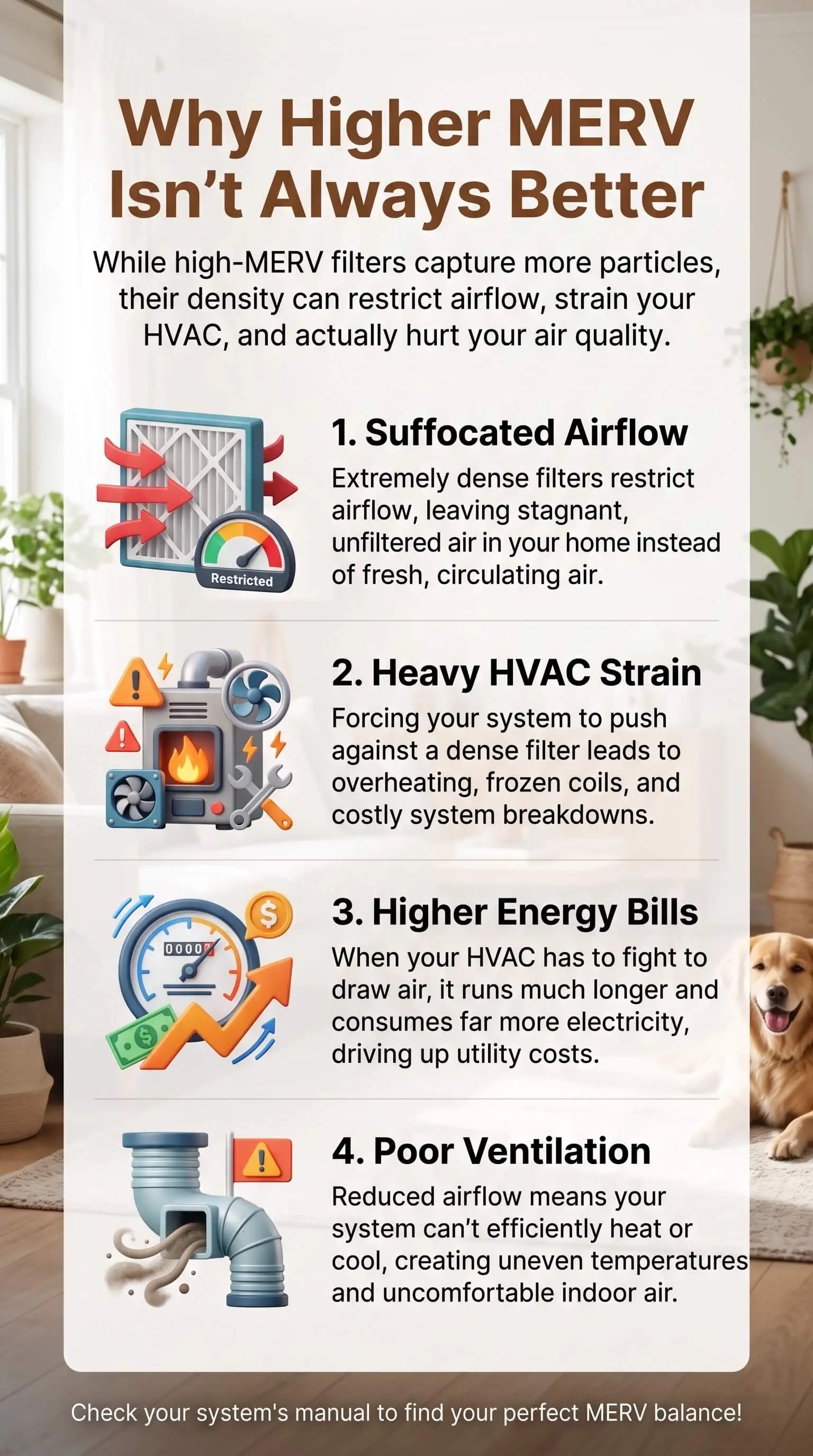
Denser media catches more, and it also pushes back harder against your blower. Technicians call that resistance pressure drop. Once it climbs past what your blower was built to handle, the whole system moves less air, so the filter removes fewer particles each hour even though every pass catches more. You also pay for longer run times and extra energy. In the cooling season, the evaporator coil can get cold enough to ice over.
Air That Bypasses the Filter Never Gets Cleaned
Air always takes the easiest path. Put a restrictive filter in a loose slot and air slips around the edges instead of pushing through the media. North Carolina's public health guidance on air-cleaning devices specifically tells homeowners to install filters securely so air can't bypass them. A snug MERV 8 can outperform a MERV 13 that rattles in its slot.
A Clogged High-MERV Filter Can Do More Harm Than Good
Fine media fills up faster, and resistance rises as it does. Leave a loaded MERV 13 in place for a few months and it can choke airflow worse than a fresh, lower-rated filter. At that point, the upgrade you paid for is working against you.
Filters Only Clean Air While the Fan Runs
Your filter sits idle every minute the blower is off. In mild weeks, when the system runs in short bursts, it treats a fraction of the air it handles in August. During those stretches, run time does more for your air than the number printed on the frame.
What Actually Drives Your Home's Air Quality
The EPA's guidance on air cleaners and air filters sets the order plainly: cut pollutants at the source and bring in clean outdoor air first, then use filtration to back both up. Here's how I'd rank it for your home:
Source control: Keep smoke outside, run the kitchen and bathroom exhaust fans, and store paint and solvents away from living spaces.
Ventilation: Open up to fresh air whenever outdoor air quality allows it.
Humidity control: Florida's long, sticky cooling season feeds mold and dust mites faster than any filter can catch them.
Filtration matched to your system: The right rating and size, sealed tight and changed on time.
How to Choose the Right MERV Rating for Your System
Check your equipment documentation. Look for a maximum MERV rating or a maximum filter pressure drop.
Measure your filter slot. A 4-inch or 5-inch media cabinet spreads air across a far more pleated surface than a 1-inch slot, so it can reach MERV 13 with less resistance. If you don't know your size, start with this standard air filter size guide.
Match the rating to your household. Pets, allergies, or nearby construction usually justify MERV 11 to 13 when your system allows it. For dander specifically, see how a tune-up helps control pet dander.
Set a change schedule. Check the filter monthly during heavy cooling months and swap it as soon as it looks loaded.
Ask for a static pressure reading at your next tune-up. That single number tells you whether your system has room for a higher rating.
Signs Your Filter Is Too Restrictive
Weaker airflow at your supply vents
Longer run cycles, or rooms that never reach the thermostat setting
Frost on the evaporator coil or refrigerant line
A whistle or rushing sound at the return grille
Energy bills creeping up when nothing about your routine has changed
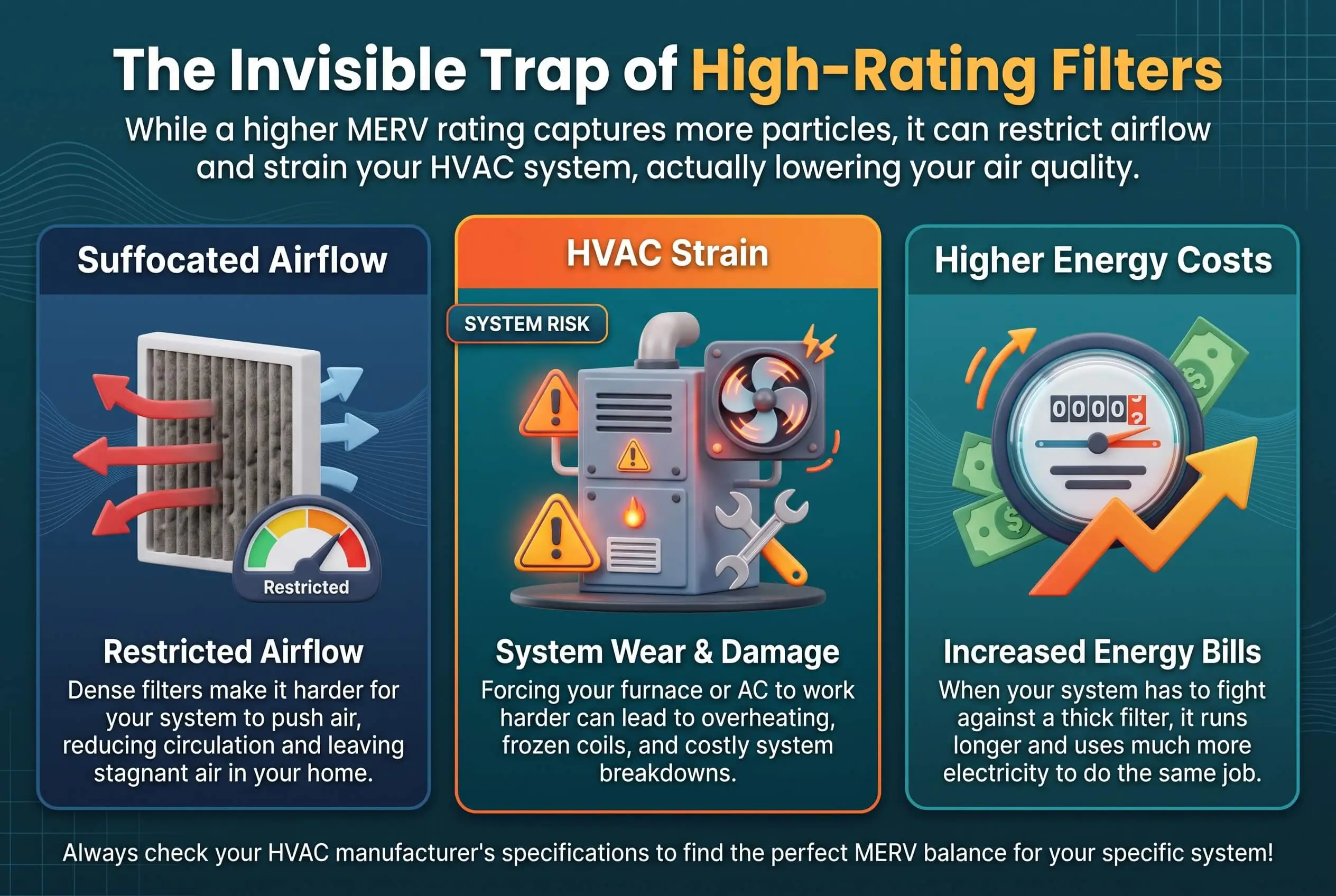
"Based on my experience running static pressure tests on tune-up calls, a MERV 13 dropped into a 1-inch slot on a system designed for basic filters often pushes total external static pressure past the blower's rating, so the home ends up moving less filtered air than it did with a MERV 8 filter. The fix is usually a deeper media cabinet or a step back to MERV 11 rather than a denser filter."
Essential Resources
ASHRAE Position Document on Filtration and Air Cleaning: ASHRAE's own position that a filter's performance in a home depends on airflow, installation, and upkeep, not lab results alone.
NAFA Filtration for the Residential HVAC Industry: Best-practice guidance on choosing, installing, and maintaining home filters.
Understanding MERV, NAFA User's Guide: A Department of Energy Building America library entry pointing to the industry's plain-language guide to the ASHRAE 52.2 test.
American Lung Association: Air Cleaning: Covers filter upgrades, change timing, and why your filter only works while the fan runs.
North Carolina Public Health: Air-Cleaning Devices: Practical advice on secure installation, filter bypass, and airflow resistance.
Public Health Seattle and King County: HVAC Systems: A short list of questions to ask your HVAC specialist before you upgrade.
HEPA Filter Standard: How the HEPA standard differs from MERV, and why it rarely fits a home HVAC system.
Supporting Statistics
Americans spend about 90 percent of their time indoors, where some pollutants often reach concentrations 2 to 5 times higher than typical outdoor levels. (EPA Report on the Environment)
More than 106 million people in the United States live with asthma, allergies, or both, including about 82 million with nasal allergies. (Asthma and Allergy Foundation of America)
Nearly half of the energy used in a home goes to heating and cooling, so any filter that makes your blower strain shows up on your utility bill. (ENERGY STAR)
Final Thoughts
Here's where I land. The MERV number on the box is a starting point, and too many people treat it as the whole answer. For most homes, a snug MERV 8 to 13 filter in the right size, changed on schedule, does more for your air than the highest rating your slot can physically hold. If MERV 13 is your goal, confirm your system can breathe through it first. And think of the filter as your last line of defense, the layer that works best after you've handled pollutant sources, ventilation, and humidity.
Frequently Asked Questions
Is MERV 13 too high for a home HVAC system?
Not always. Plenty of systems run MERV 13 without trouble, especially with a 4-inch or 5-inch media filter. Systems built around basic 1-inch filters may struggle. Check your equipment documentation, or ask a technician to measure static pressure before you upgrade.
What MERV rating is best for allergies and pets?
MERV 11 filter usually makes sense for homes with allergies or pets, as long as your system can handle the extra resistance. Pair it with source control, like regular vacuuming and pet grooming, for the biggest improvement.
Can a 4-inch filter handle a higher MERV rating?
Usually, yes. A deeper filter packs in far more pleated surface, which spreads the airflow out and lowers resistance at the same rating. Your system does need a housing built for that depth.
Is a MERV 16 filter the same as HEPA?
No. HEPA is its own standard, and under the U.S. Department of Energy definition, a HEPA filter must capture at least 99.97 percent of 0.3-micron particles. Most home systems can't pull enough air through true HEPA media to use it.
How often should I change a high-MERV filter?
Check it every month during heavy heating or cooling stretches, and replace it whenever it looks loaded, at least every three months. Homes with pets, construction dust, or a long Florida cooling season may need changes more often.
Choose the MERV Rating Your System Can Breathe Through
Better home air quality comes from the MERV air filter your system can actually pull air through, not the biggest number on the box. Start with the chart, then ask your technician to check static pressure at your next tune-up before you move up a rating.